
What delivery apps really cost a restaurant: commission explained with real numbers
Most restaurant owners know their commission rate. Far fewer have worked out what it adds up to over a year – or how it compares with the profit they actually make on an order. Here is the maths, line by line, with an example you can swap your own figures into.
Eatzino team · Updated

How delivery commission works
A delivery marketplace charges a percentage of every order that comes through its app. That percentage depends on who delivers:
- You deliver with your own drivers. The platform only brings the order. Restaurants in Germany commonly report around 13–14 % for this model on Lieferando, the market leader (trusted.de).
- The platform's couriers deliver. The platform brings the order and the driver. Rates of around 30 % are widely reported for this model.
On top of the commission there can be further costs: payment processing, an order or service fee, paid placement in the app's rankings, and the tablet or hardware. The platforms don't publish one fixed price list – Lieferando, for example, keeps its partner terms out of public view and may agree different prices with each restaurant (SumUp). So the only figure that counts is the one on your invoice.
Take your last monthly statement from each platform and divide everything they kept – commission, fees, ads – by your gross sales on that platform. That is your real rate. It is often a few points higher than the headline number.
One order, broken down
Say a guest orders a pizza, a salad and a drink for €25.00.
| You deliver (14 %) | Platform delivers (30 %) | |
|---|---|---|
| Order value | €25.00 | €25.00 |
| Commission | €3.50 | €7.50 |
| Left for you before costs | €21.50 | €17.50 |
Now put that next to your costs. If ingredients are around 30 % of the menu price, the food in that order cost you about €7.50. At a 30 % rate, the platform's share is as large as your whole food cost. Staff, rent, energy, packaging and – if you deliver yourself – the driver all still have to come out of what is left.
Restaurant profit margins are thin; a net margin in the single digits is normal. Let's be generous and say 8 %: that is €2.00 profit on a €25 order. A 14 % commission (€3.50) is already larger than that. This is why so many owners raise their prices on the apps – and why guests notice that the same pizza costs more there than at the counter.
What it adds up to over a year
Single orders look small. Monthly totals don't.
| Online sales per month | 14 % commission per year | 30 % commission per year |
|---|---|---|
| €3,000 | €5,040 | €10,800 |
| €8,000 | €13,440 | €28,800 |
| €15,000 | €25,200 | €54,000 |
A pizzeria with €8,000 a month in app orders hands over €13,440 a year when it delivers itself, and €28,800 when the platform delivers. That is a new oven, a part-time employee, or a very good year instead of an average one.
What the commission actually buys you
It would be dishonest to say the commission buys nothing. A marketplace gives you:
- Reach. Hundreds of thousands of people already have the app installed and open it when they are hungry. A new guest who has never heard of you can find you there.
- Payment. Card, PayPal and other methods, handled for you.
- Couriers – in the 30 % model only.
What it does not give you is the guest. On a marketplace the person who orders is the platform's customer. You usually don't get their contact details, you can't invite them back, and next Friday the same app shows them your competitor first. So the real question isn't "app or no app". It is: should a regular who already loves your food still cost you 14–30 % every single time they order?
Discovery on the apps, regulars on your own channel
The setup that works for most independent restaurants has two layers:
- Stay on the marketplaces for discovery. New guests find you there. Treat the commission as your marketing budget for first orders.
- Give your regulars a direct way to order. Your own ordering page, linked from your Google Business Profile, your website and your Instagram bio. No commission on those orders.
- Move people over at every touchpoint. A flyer in every delivery bag ("Order direct next time – same food, better price"), a QR code on every table, a line on the receipt.
Even moving a third of your repeat orders to your own channel makes a large difference. With €8,000 in app sales at 14 %, shifting a third (about €2,670 a month) saves around €4,480 a year – at 30 % it saves €9,600.
Commission or a fixed monthly price: where is the break-even?
Ordering systems for your own channel come in two flavours: a percentage per order (often lower than the marketplaces, but still a share) or a fixed monthly price.
With a fixed price, the break-even is easy to calculate: monthly price ÷ commission rate.
- At €79 a month you are better off than with a 14 % commission from about €565 in online sales per month.
- At €199 a month the line is about €1,420 per month – roughly two orders a day.
Above that line, every additional order is cheaper on a fixed price. And the busier you get, the bigger the gap becomes – a commission grows with your success, a fixed price doesn't.
Questions to ask before you sign any contract
Whichever platform you use, ask these questions in writing:
- Is the commission calculated on the order value with or without VAT, and does it include the delivery fee?
- Which fees come on top: payment processing, per-order fees, hardware, marketing packages?
- Is there a minimum contract term or a notice period?
- Do I get the guests' contact details or can I export my orders?
- May I offer lower prices on my own channel than on your app?
- What happens to my ranking if I don't book paid placement?
If the answers are vague, that tells you something too.
How Eatzino handles this
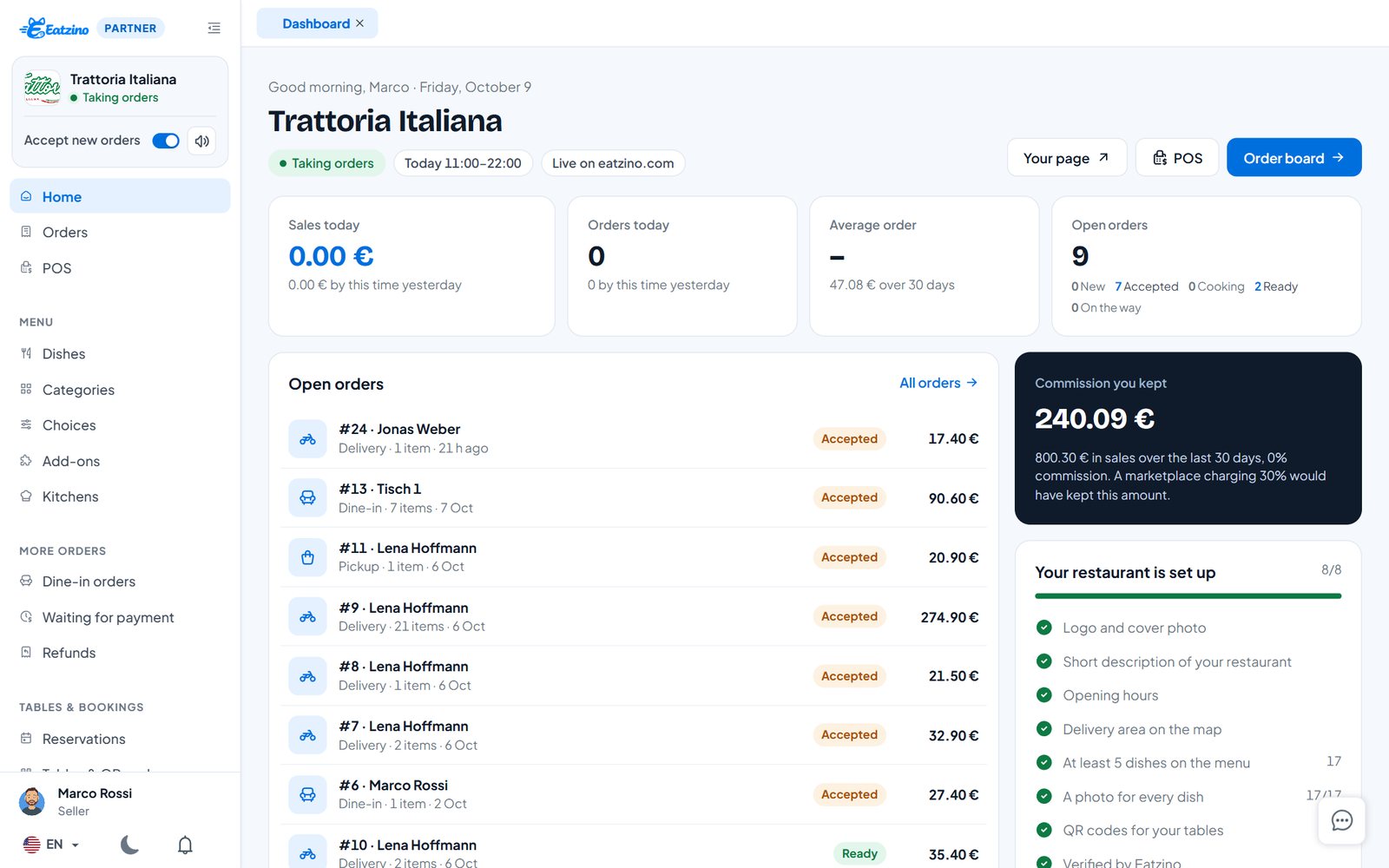
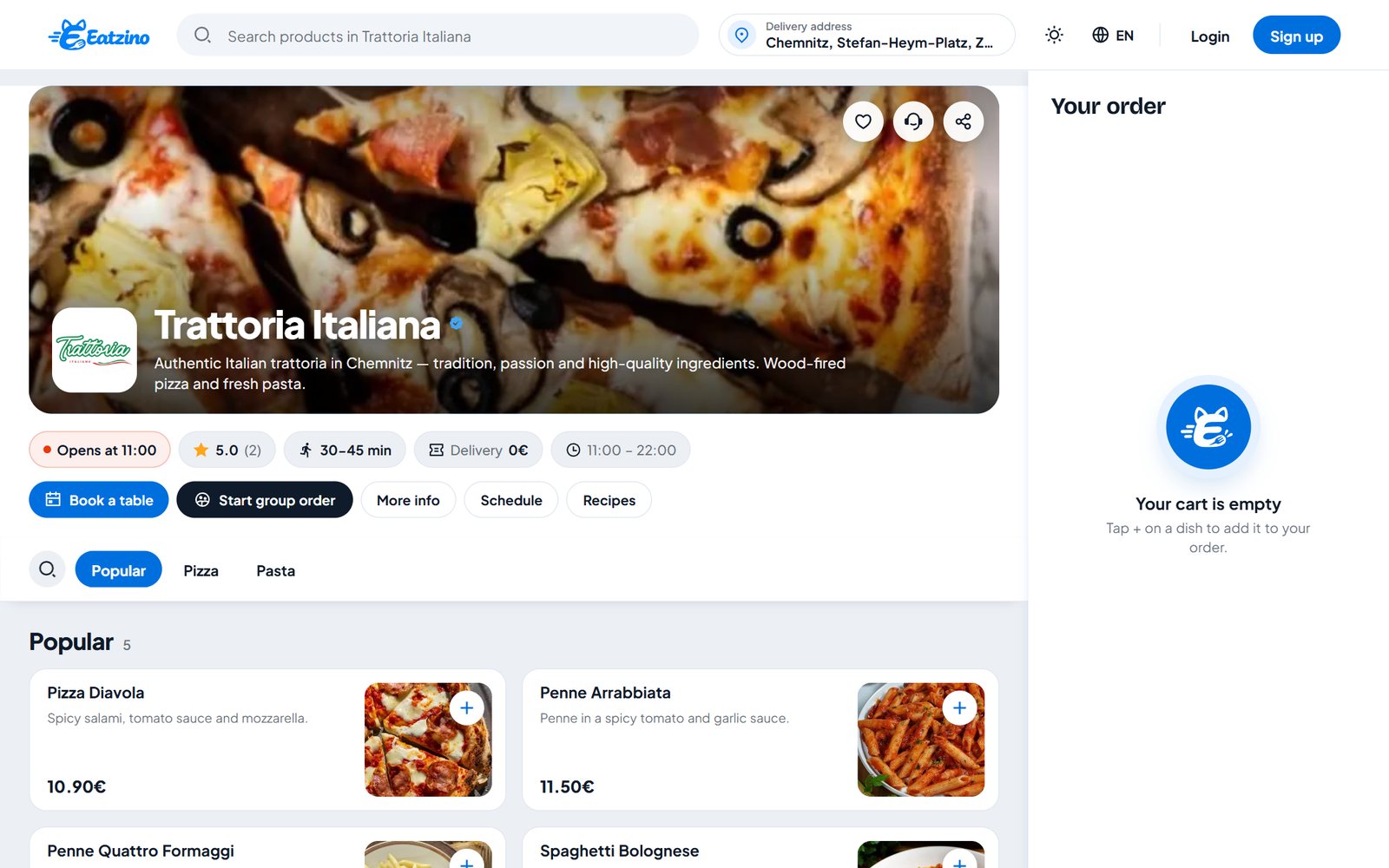
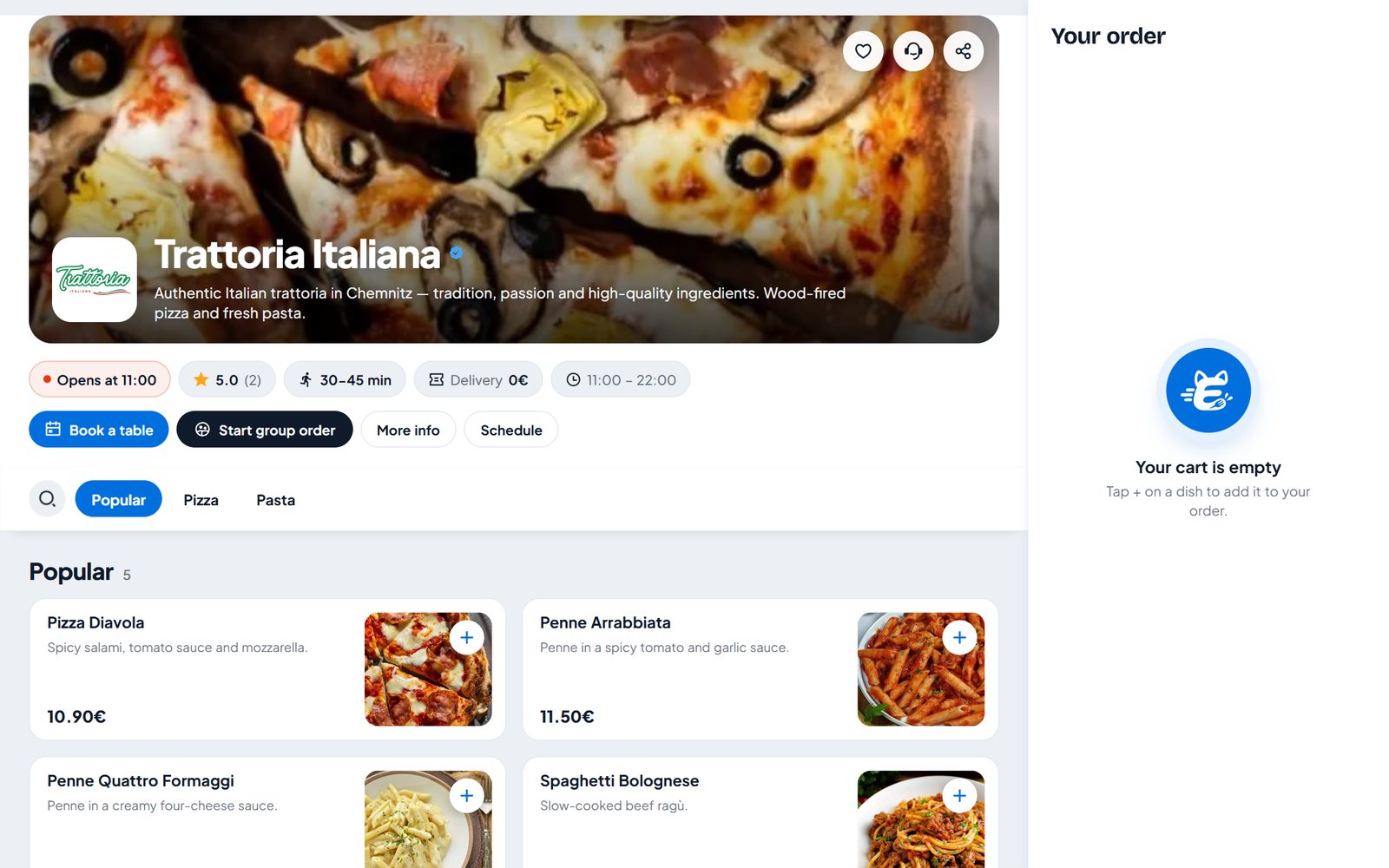
We built Eatzino because we think a regular guest shouldn't cost a restaurant a quarter of the bill. Restaurants pay one fixed monthly price – 0 % commission on every order – and get their own restaurant page, an order button for their website, a POS, a QR table menu and table reservations in every package.
To be clear about what we don't do yet: guests currently pay cash on delivery or at pickup (online card payment is in preparation), and deliveries are made by your own drivers with our free driver app or picked up by the guest. Eatzino is new, so it won't replace the reach of a big app on day one – it's the channel you move your regulars to. See how the packages work or read our honest comparison of the big platforms and your own ordering system.
Questions and answers
How much commission does Lieferando take?
Lieferando doesn't publish a fixed rate and terms can differ per restaurant. Restaurants commonly report around 13–14 % when they deliver themselves and around 30 % when Lieferando's couriers deliver. Check your own invoice for the exact rate and any extra fees.
Can I charge different prices on delivery apps and on my own website?
Many restaurants do – it's how they cover the commission. Check your platform contract first, as some contracts have rules on pricing.
Is a fixed monthly price always cheaper than commission?
No. If you only get a handful of online orders a month, a commission can be cheaper. Divide the monthly price by your commission rate: above that amount of online sales per month, the fixed price wins.
Should I leave the delivery apps completely?
Usually not. The apps are good at bringing new guests. The money is in moving your regulars to a direct channel where you pay no commission.
Lieferando, Wolt, Uber Eats or your own ordering system? An honest comparison
Reach, costs, delivery, payment and who owns the guest: how the big delivery marketplaces compare with your own commission-free ordering system – including where we fall short.
How to add online ordering to your restaurant website (WordPress, Wix and plain HTML)
Step by step: put an order button or your full menu on your own restaurant website – with WordPress, Wix, Squarespace, Jimdo or one line of HTML. Without commission.